The Real ROI of Multi-Agent AI: Beyond Hype to Measurable Business Impact
Posted by: Syncloop | April 02, 2026
"What's the ROI on this AI initiative?" It's the question that separates pilot projects from production deployments. Boards ask it. CFOs demand answers. And too often, the response is hand-waving about "transformational potential" rather than measurable business impact.
Multi-agent AI can deliver real, measurable ROI. But understanding where that value comes from — and how to measure it — requires moving beyond the hype to concrete value drivers.
The Three ROI Channels
⚡
Channel 01
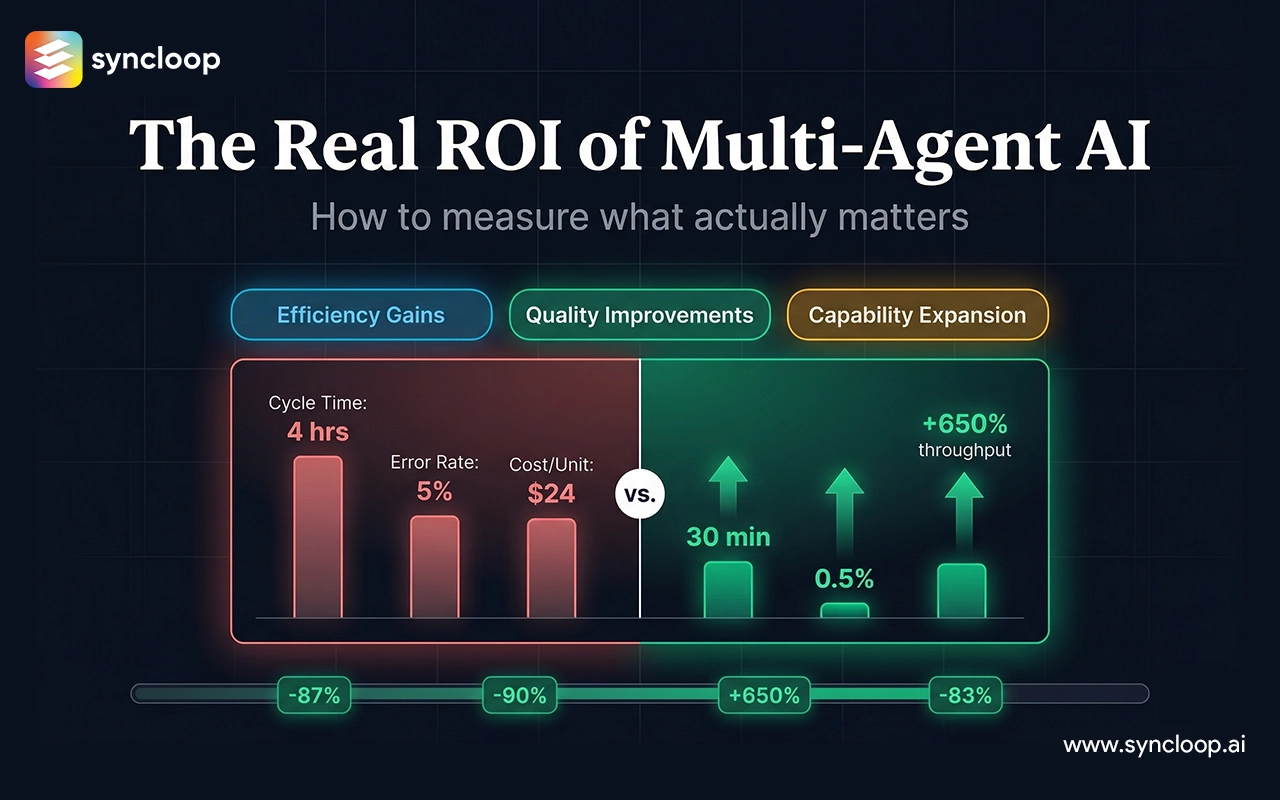
Efficiency Gains
Tasks completed faster or with fewer resources. A process that took 4 hours now takes 30 minutes. Straightforward to measure: time saved, resources freed, throughput increased.
Easy to measure
✅
Channel 02
Quality Improvements
Reduced errors, increased consistency, better outcomes. Error rates drop from 5% to 0.5%. Requires baseline data to demonstrate improvement over time.
Requires baseline
🚀
Channel 03
Capability Expansion
Doing things that weren't possible before. Processes too complex for automation become automated. Hardest to measure but often delivers the largest returns.
Largest upside
ROI measurement requires documented baselines. Without before-state data, you can't demonstrate improvement — or justify continued investment.
Measuring Efficiency Gains
Efficiency measurement starts with baselines. Before deploying AI, document current state: How long does the process take? How many people are involved? What's the throughput? Without this baseline, you can't demonstrate improvement.
Key efficiency metrics include cycle time, throughput, resource utilization, and cost per transaction. Be careful about comparing AI performance to theoretical human capacity rather than actual performance — this inflates perceived gains and destroys credibility.
Measuring Quality Improvements
Quality measurement requires defining what "quality" means for your specific process — error rates, consistency, compliance adherence, or customer satisfaction. Again, baselines are essential.
Quality improvements often have outsized financial impact. An error that requires rework costs more than doing it right the first time. Compliance failures trigger fines and remediation costs. Customer dissatisfaction drives churn. Translating quality improvements into financial impact requires understanding these downstream costs.
The Hidden Costs
Honest ROI calculation requires accounting for all costs, not just obvious ones.
💻
Infrastructure Costs
Compute, storage, and networking for AI workloads. Often higher than traditional applications and scale with usage. Frequently underestimated in initial business cases.
🔗
Integration Costs
Connecting AI systems to existing business processes and data sources. Often the largest underestimated cost — integration takes longer and requires more expertise than teams anticipate.
🔧
Ongoing Maintenance
Monitoring, updating, and improving AI systems post-deployment. AI isn't "set and forget" — it requires continuous attention to maintain performance and accuracy over time.
👥
Change Management
Training, process redesign, and organizational adjustment. People need to learn new ways of working. These costs are real even if they're hard to quantify upfront.
Most AI cost estimates only capture infrastructure. Hidden costs — integration, maintenance, and change management — represent the majority of real investment.
Building the Business Case
A complete AI business case includes quantified benefits across all three channels, realistic cost estimates including hidden costs, timeline expectations, and risk factors. Don't oversell — inflated projections might secure initial funding but create credibility problems when results fall short.
Typical ROI Materialization Timeline
30–90 Days Post-Deployment
Initial efficiency gains appear. Process cycle times drop. Throughput begins climbing. Early wins visible but not yet fully measurable.
3–6 Months
Quality improvements measurable with statistical confidence. Error rates stabilize. Compliance data accumulates. ROI narrative becomes defensible to leadership.
12–18 Months
Full ROI realization as systems mature and adoption spreads. Capability expansion benefits begin compounding. Cost-per-unit metrics reach steady state.
The fear is real. HashiCorp changed Terraform's license. Redis went from open to restricted. MongoDB, Elastic, Confluent—the list of "open-source" platforms that shifted to more restrictive terms keeps growing.