How Payment Failures Are Driving Revenue Leakage for CFOs
Posted by: Syncloop | May 06, 2026
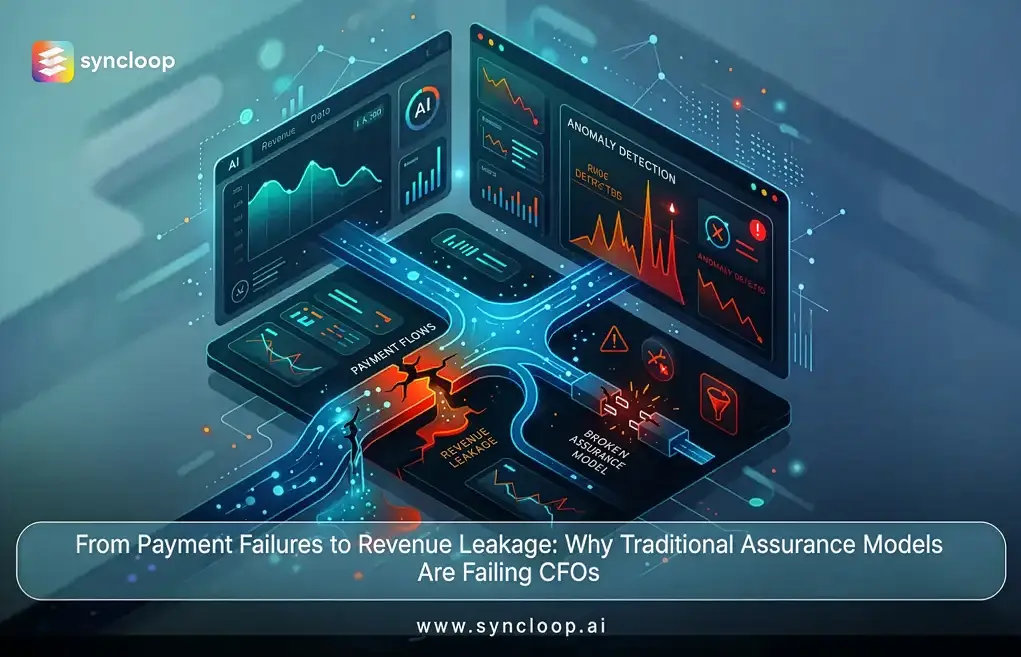
In today’s rapidly expanding digital economy, payment failures are no longer due to operational issues. They have emerged as a strategic financial threat. What once might have been dismissed as isolated errors now plays a significant role in ongoing revenue leakage that evades traditional assurance systems. CFOs and financial leaders responsible for growth, profitability, and compliance, ignoring this can face major financial loss.
Nowadays, modern finance functions are dealing with high-volume transactions, complex billing structures and real-time customer expectations. In such a highly-demanding business environment, a failed payment does not just cost a single transaction. It can cascade into various other financial gaps, such as lost renewals, delayed revenues, compliance gaps, and serious blind spots. This blog post highlights how payment failures can create a big trouble for today’s SAAS –based companies.
Understanding Payment Failures and Their Hidden Impact
Payment failures can occur for various reasons, such as expired cards, declined authorizations, gateway disruptions, mismatches in billing data, and even regional banking issues. Though for customers it can be a momentary frustration, for the finance team, it is a silent leak in the revenue pipeline. In highly transactional environments, subscriptions, recurring billing, and usage-based models, these issues quietly erode revenue without ever showing up as a headline in financial reports.
What gets less attention is how these failures propagate:
- Failed transactions often go unnoticed until reconciliation
- Partial payments are misclassified or overlooked
- Finance teams spend days chasing exceptions manually
What Is Revenue Leakage and Why CFOs Should Care
Revenue leakage is the financial gap when earned revenue fails to make it into financial reporting or the bank. It is not worthless assets. It is not bad debt. It is the money the business legitimately earned that simply slipped through operational cracks.
Research says, across various industries, organizations lose 2-5% or more of total revenue to leakage annually due to issues like payment failures, billing errors, mismanaged renewals, and ineffective reconciliation. For mid- and large-enterprise operations, this translates into millions of dollars in invisible loss before a single month-end close.
For CFOs, unchecked revenue leakage can become a core financial risk:
- Forecast accuracy
- Strategic planning
- Cash flow optimization
- Investor confidence
Limitations of Traditional Assurance Models
Despite this urgency, most finance teams and businesses still rely on legacy assurance models that were not designed for real-time complexity. Following are the reasons why SaaS companies should stop trusting on traditional assurance models:
Manual Processes and Delayed Insights
Traditional assurance relies on spreadsheets, ad‑hoc tickets, and staged reconciliation cycles. These reactive methods only find problems after revenue has already leaked. By then, teams are chasing history, not preventing loss.
Lack of Real‑Time Visibility
Finance leaders deserve immediate insights, not monthly surprises. Old systems only flag issues post‑facto, leaving CFOs with stale data just when decision speed matters most.
Inefficiency in Handling Complex Transactions
Global payment systems, multi‑currency billing, tiered subscriptions, and usage‑based models explode operational complexity. Legacy tools buckle under this load, creating more exceptions than they resolve.
How Revenue Leakage Directly Impacts Business Growth
Revenue leakage is not a minor variance. It is a direct hit to growth and financial performance. It skews margin visibility, masks churn indicators, and weakens the reliability of operational and revenue forecasts. For instance, in high-growth SaaS businesses or subscription models, a failed set of automated renewals due to payment failures can lead to a chain of losses, not just hampering one transaction. It reduces customer lifetime value, weakens retention metrics, and skews churn and ARR (Annual Recurring revenue) forecasts, and many more. The finance team who does not contribute to strategic forecasting and spends days hunting down exceptions can surely lag behind in this booming tech-driven world.
The Shift Toward AI‑Driven Revenue Assurance
The limitations of traditional models are why top finance organizations are investing in AI‑driven revenue assurance today. Instead of waiting for monthly audits or manual fixes, AI‑powered systems provide:
Real‑Time Monitoring and Alerts
AI systems watch every transaction, detect payment failures instantly, and escalate issues without human lag. This continuous oversight closes leaks as they happen, not after they become material.Predictive Analytics for Risk Prevention:
AI predicts which accounts or transactions are likely to fail based on patterns. It doesn’t just notify you, it prevents loss by alerting teams before revenue slips away. Platforms like Syncloop.ai adapt intelligent monitoring across billing, payments, reconciliation, and reporting, thereby closing gaps that legacy systems simply cannot see.
Key Benefits for CFOs and Financial Leaders
For top-level executives, the value of modern revenue assurance is not at all hype, but it is a measurable impact. Here’s why you should make a hurry to embrace AI-powered platforms to detect these flaws:
- Minimized Financial Risk: Automated detection and real‑time alerts prevent revenue drives from turning into data blind spots.
- Faster Decision Making: With continuous insights, CFOs can forecast more accurately and reallocate capital more strategically.
- Operational Efficiency: Teams spend less time reconciling failures and more time improving margins and strategy. This is the difference between reactive finance and strategic finance.
Conclusion: Why CFOs Must Rethink Their Assurance Strategy Now
In a world where payments are digital, global, and instantaneous, traditional assurance systems are outpaced and outmatched. Payment failures are not just isolated errors, they are the gateway to deeper revenue leakage if left unaddressed. CFOs and financial leaders cannot afford to treat revenue assurance as an annual check‑in or periodic audit. Modern finance requires systems that think ahead, detect continuously, and react immediately.
Back to Blogs