The Hidden Cost of Manual Regulatory Reporting in US Financial Institutions
Posted by: Syncloop | June 28, 2026
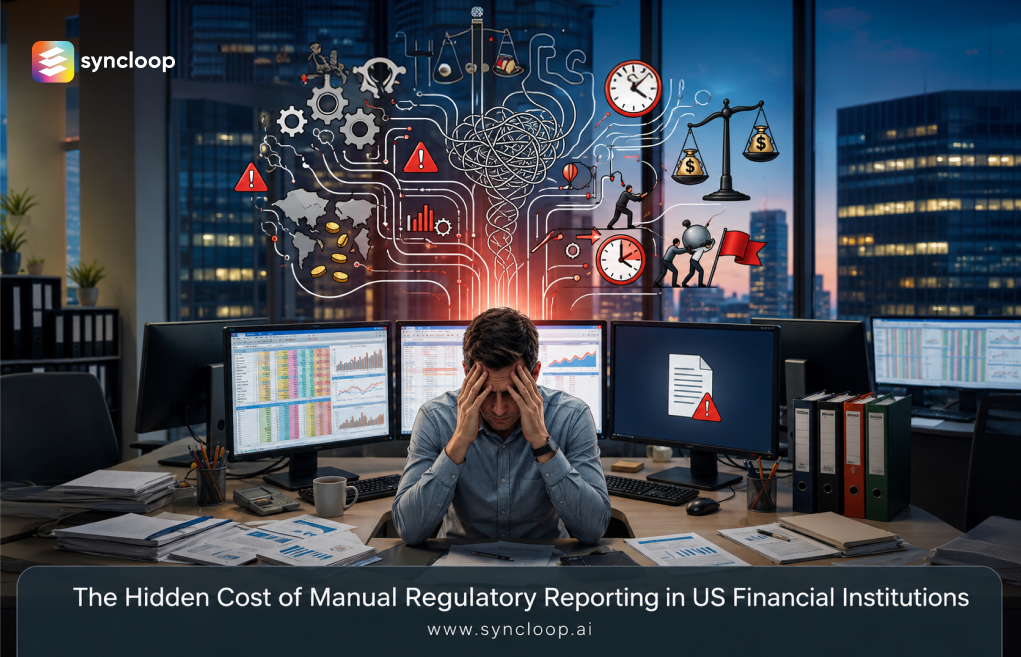
Manual regulatory reporting continues to create significant hidden costs for US financial institutions, including operational inefficiencies, compliance risks, and delayed decision-making. This blog explores why manual processes persist, their true financial and regulatory impact, and how AI-driven workflow automation can streamline reporting, improve accuracy, and strengthen audit readiness across modern banking environments.
Across US financial institutions, regulatory reporting is treated as a non-negotiable compliance function. But what often goes unnoticed is the operational cost hidden beneath the process itself. Despite significant investments in digital transformation, many banks, credit unions, and financial service providers still rely on spreadsheets, fragmented systems, and email-driven workflows to meet reporting obligations.
The result is a silent inefficiency that is not always visible in financial statements. But it is consistently reflected in delayed reporting cycles, rising operational burden, and avoidable compliance exposure. This is why manual regulatory reporting is no longer just inefficient, but structurally expensive too.
In this blog, we will understand the real cost of manual reporting processes and what are the major risks associated with it.
Why Manual Regulatory Reporting Still Exists in Modern Financial Institutions
- Legacy core banking systems that were never designed for modern compliance reporting
- Departmental silos where compliance, finance automation platform and operations work independently
- Heavy reliance on human validation for data aggregation and submission
- Lack of unified regulatory data infrastructure
The Real Financial Cost of Manual Reporting Processes
Manual regulatory reporting is not just a compliance burden. It is a recurring operational expense. Financial institutions majorly absorb costs in areas that are rarely isolated in reporting discussions, which include:
- Labor-intensive reporting cycles Teams spend days or even weeks preparing submissions that should be automated
- Overtime and staffing pressure: Regulatory deadlines often extend working hours across compliance and finance teams
- Reconciliation inefficiencies: Data mismatches across systems require repeated validation cycles
- Delayed submissions: Late reporting increases regulatory scrutiny and operational risk exposure
- Opportunity cost: Skilled professionals spend time compiling reports instead of analyzing financial insights
Over time, these inefficiencies compound into a significant drag on operational performance.
Compliance Risks Created by Human-Driven Reporting
Manual processes introduce variability and in regulated environments, variability is risk. Common challenges include:
- Data entry errors during consolidation from multiple systems
- Version control issues where teams operate on outdated datasets
- Audit inconsistencies due to fragmented documentation trails
- Increased exposure to regulatory penalties and reputational risk
Regulatory bodies such as the SEC, FINRA, OCC, and Federal Reserve expect accurate, timely, and traceable reporting. Even minor discrepancies can lead to extended audits or corrective scrutiny. In manual environments, maintaining consistent audit readiness becomes an ongoing challenge rather than a built-in capability.
How AI and Automation Are Transforming Regulatory Reporting
The shift toward automation is not about replacing compliance teams, it is about removing friction from repetitive processes. Modern financial institutions are increasingly adopting AI-driven workflow orchestration and intelligent automation systems, enabling:
- End-to-end automated reporting workflows
- Centralized data aggregation across systems
- Automated validation and reconciliation before submission
- Real-time tracking of reporting status and audit readiness
- Predictive identification of compliance gaps before they escalate
Platforms like Syncloop.ai are enabling this shift in planning financial workflows across fragmented systems and reducing dependency on manual coordination. The impact is clear and prominent. The automation through AI results in less manual effort, higher accuracy, and stronger regulatory confidence.
Strategic Benefits of Automated Regulatory Reporting
When financial institutions move from manual workflows to automated regulatory compliance reporting, the impact is not just operational improvement. It fundamentally changes how compliance functions operate.
Faster reporting cycles with reduced dependency on manual coordination
Automation removes the need for multiple teams to manually compile and validate data. Reporting cycles become more streamlined, allowing institutions to meet deadlines with less operational friction and fewer last-minute escalations.
Lower operational risk due to standardized workflows
Automated systems ensure every reporting step follows a consistent and controlled process. This reduces the risk of human error, missing data, or inconsistent interpretations across departments.
Higher reporting accuracy through automated validation layers
Data is continuously checked and validated before submission. This reduces inaccuracies caused by manual consolidation and ensures reports align more closely with regulatory expectations.
Improved decision-making enabled by real-time compliance visibility
Instead of waiting for reporting cycles to close, leadership teams gain ongoing visibility into compliance status. This allows faster identification of issues and more informed operational decisions.
Scalable reporting infrastructure that grows with regulatory complexity
As regulatory requirements evolve, automated systems can adapt without increasing manual workload. This makes scaling across new regulations or business units significantly more manageable.
What Financial Institutions Should Look for in a Regulatory Automation Partner
Not all automation solutions are built for regulated environments. Financial institutions should evaluate partners based on:
Security and compliance readiness:
Modern financial institutions should check whether the automation system ensures the solution meets strict financial data protection and regulatory security standards.
Integration capability:
They should ensure whether the automation partner enables seamless connectivity with both legacy systems and modern banking platforms.Workflow coordination intelligence:
They should check whether automation manages and coordinates end-to-end compliance processes intelligently.Flexibility in reporting logic:
Financial institutions should check whether the automation system has smooth adaptability to changing regulatory requirements and reporting formats without major system changes.
Transparency and audit visibility:
Emerging financial institutions across the US should check whether it provides complete traceability across workflows for clear audits and regulatory review.
Back to Blogs