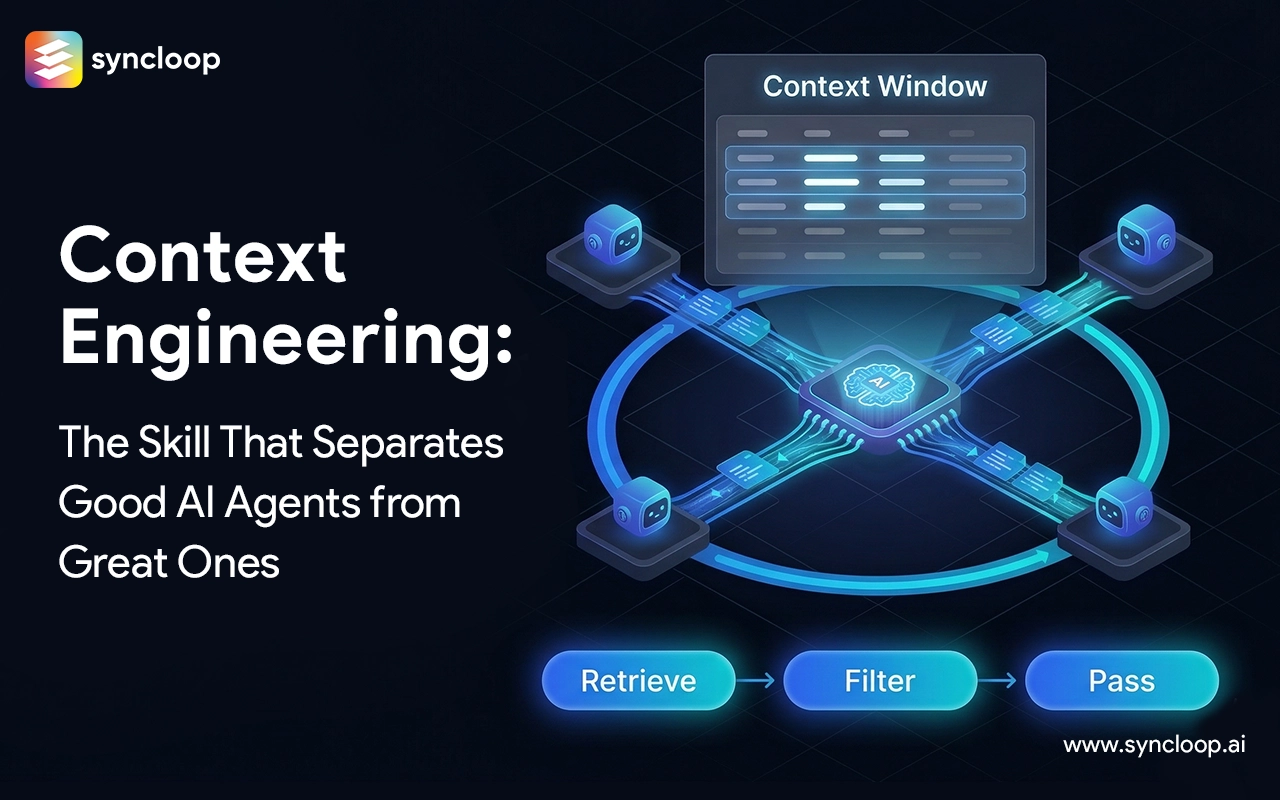
Context Engineering: The Skill That Separates Good AI Agents from Great Ones
Posted by: Syncloop | April 06, 2026
Here's a pattern that plays out constantly in AI development: Two teams build similar agents using the same underlying models. One works reliably in production; the other fails unpredictably. Same model, different outcomes.
The difference is usually context engineering — how well each team manages the information flowing to and between their agents. Context engineering isn't glamorous. It doesn't make headlines like new model releases. But it's emerging as the critical discipline that separates AI systems that work from ones that don't.
What Context Engineering Actually Means
Context is the information an agent uses to make decisions: the task description, relevant data, conversation history, available tools, constraints, examples. Everything that shapes what the agent does with a given input.
Context engineering is the discipline of managing this information deliberately — what to include, what to exclude, how to structure it, when to retrieve it, how to pass it between agents. It matters because AI agents are fundamentally context-dependent. Give the same agent the same input with different context, and you get different outputs — sometimes radically different.
Context shapes agent behavior as much as the underlying model — two agents with the same input behave entirely differently based on what context they receive.
The Four Pillars of Context Engineering
Context engineering rests on four distinct disciplines. Each one addresses a specific failure mode. Together they form a complete approach to managing information in AI systems.
Pillar 01
Context Retrieval
Getting the right information at the right time. The challenge isn't retrieval itself — it's relevance. Retrieving everything is expensive and counterproductive; irrelevant context confuses the agent.
Pillar 02
Context Compression
Making information dense without losing meaning. Context windows have limits. You can't include everything — summarize long documents, extract key facts, use structured formats that convey more with fewer tokens.
Pillar 03
Context Passing
Moving information between agents without loss or distortion. In multi-agent systems, one agent's output becomes another's input. Poor context passing is where many multi-agent systems break down.
Pillar 04
Context Exclusion
Knowing what not to include. This might be the hardest pillar. Irrelevant context wastes tokens and misdirects the agent. Outdated context can override current information. Deliberate exclusion is as important as inclusion.
Common Context Engineering Mistakes
The four most common context engineering failures — and why each produces different types of unreliable agent behavior.
Practical Context Engineering Techniques
Structured context formats — Use consistent, machine-readable structures rather than free-form text. Structured context is easier to manipulate, filter, and compress. It also reduces ambiguity in how the agent interprets information.
Task-specific retrieval — Don't retrieve generically — tailor retrieval to the specific task. Different tasks on the same data might need different context.
Progressive context loading — Start with minimal context and add more only if needed. This reduces token usage for simple cases while ensuring complex cases get what they require.
Context validation — Check that context is internally consistent, fresh enough for the task, and complete for the required decisions. Catch problems before they cause agent failures.
Explicit handoff protocols — Define exactly what information passes between agents, in what format, at what stage. Don't rely on implicit conventions — document and enforce the protocols.
Context Engineering as Competitive Advantage
Here's the strategic reality: underlying models are commoditizing. The same foundation models are available to everyone. The differentiation increasingly comes from what you do with those models — and context engineering is a major part of that.
Organizations that develop strong context engineering capabilities will build more reliable AI systems than competitors using the same models. That reliability compounds into trust, adoption, and business value. Context engineering might be the most underleveraged skill in AI development today.
The fear is real. HashiCorp changed Terraform's license. Redis went from open to restricted. MongoDB, Elastic, Confluent—the list of "open-source" platforms that shifted to more restrictive terms keeps growing.