Building Smarter Workflows with Multi-Agent Syncloop AI
Posted by:
Luthar Martin | March 13, 2025
Introduction
Every business, regardless of its size or industry, runs on
workflows. These workflows—whether it’s processing an invoice,
onboarding a new employee, or handling a customer support
request—are the engine behind day-to-day operations. But too
often, these workflows are riddled with inefficiencies: manual
steps, delayed approvals, disconnected systems, and human
error.
Traditional automation tools attempted to solve this by
turning repetitive tasks into rule-based actions. While
helpful, these tools often fall short in today’s dynamic and
complex business environments. They lack adaptability,
contextual understanding, and the ability to collaborate
across systems in real-time.
Enter Multi-Agent Syncloop AI—a platform designed not just to
automate workflows but to make them smarter, more
collaborative, and infinitely more scalable. By leveraging a
network of intelligent AI agents, Syncloop enables
organizations to build workflows that think, respond, and
evolve—just like a high-functioning team.
In this blog, we’ll explore how Syncloop AI helps businesses
build smarter workflows using its powerful multi-agent
architecture, and why this approach is the future of
intelligent automation.
Why Traditional Workflow Automation Falls Short
The concept of automating business processes isn't new. From
early scripting tools to RPA (Robotic Process Automation)
platforms, companies have long sought ways to reduce manual
labor and streamline operations. But traditional automation
often comes with limitations:
- It’s rigid and hard to adapt when workflows change.
-
It doesn’t support real-time collaboration or
decision-making.
-
It requires extensive developer involvement to set up and
maintain.
-
It lacks context awareness or the ability to handle
unstructured data.
These shortcomings mean that while some steps may be faster,
the workflow as a whole remains fragmented and fragile.
What businesses need today are workflows that are not just
automated—but intelligent. Workflows that are flexible,
adaptive, and able to collaborate across multiple systems,
data sources, and teams.
That’s exactly what Syncloop AI offers.
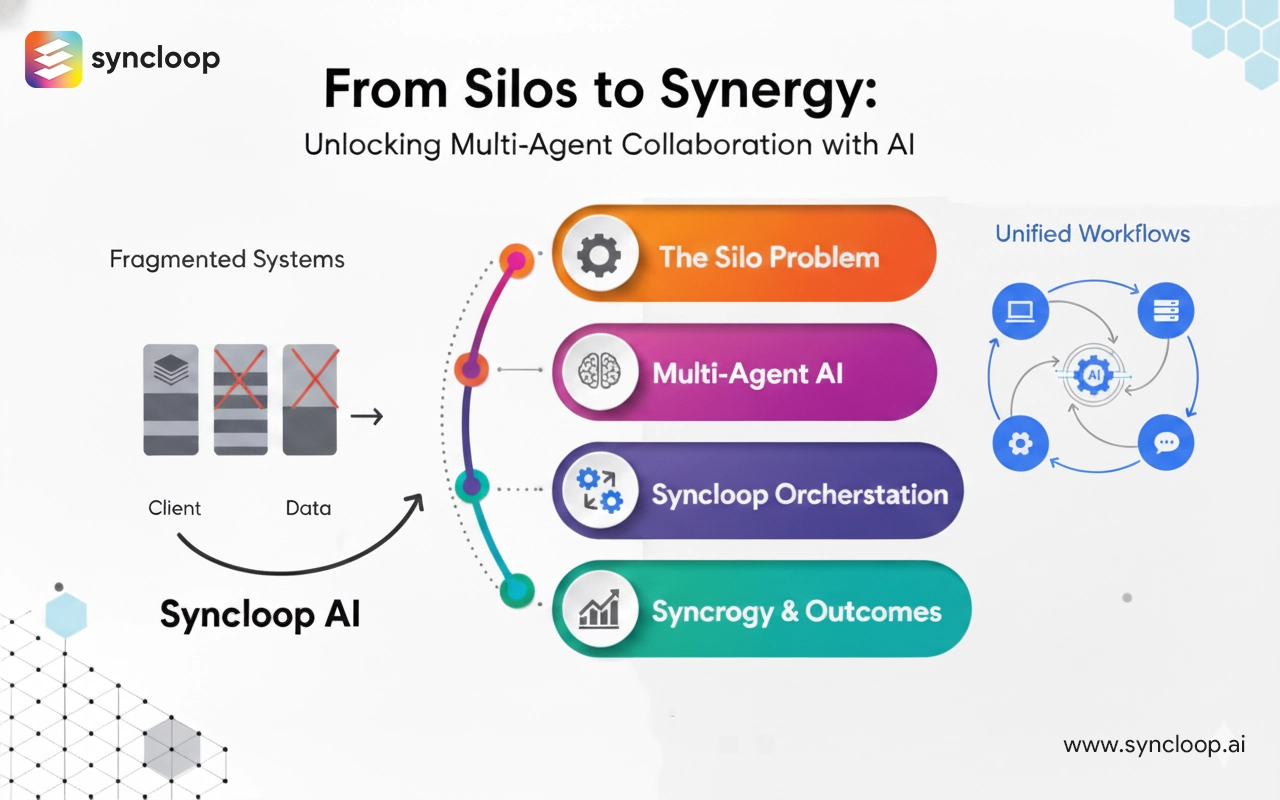
Understanding Multi-Agent Syncloop AI
Syncloop AI is built on a multi-agent architecture—a model
that mirrors real-world teamwork. Instead of having a single
system handle every step of a process, Syncloop deploys
multiple intelligent agents, each responsible for a specific
task.
These agents:
- Work autonomously but collaborate in real-time.
- Share data and context with each other.
-
Use AI models (including LLMs) to understand and act on
information.
-
Adapt to changing conditions and update their behavior
accordingly.
Imagine them as digital team members—each with their own
expertise, yet working toward a shared outcome.
This modular, agent-based system allows businesses to design
smart, distributed workflows that are more resilient,
scalable, and capable of handling complexity.
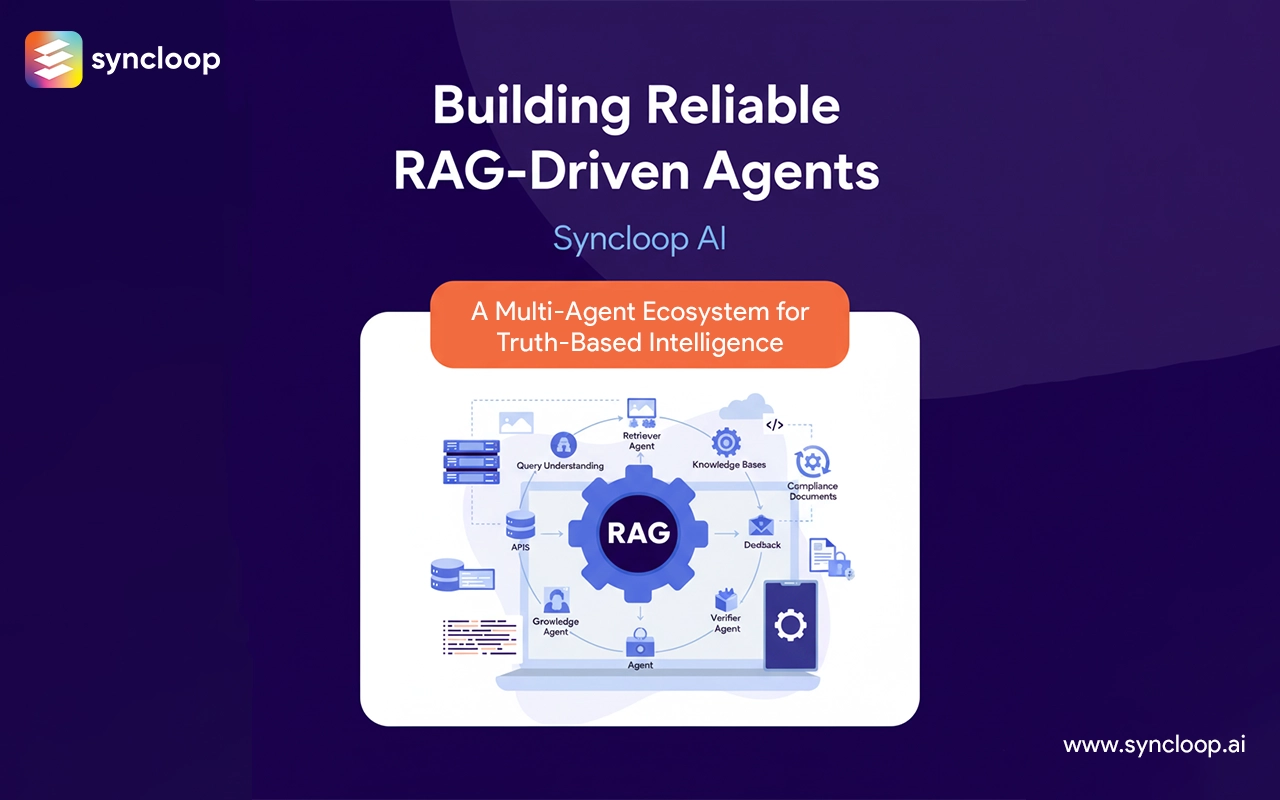
Designing a Smarter Workflow: What It Looks Like
Let’s take a look at how a smarter, multi-agent workflow might
play out using Syncloop AI:
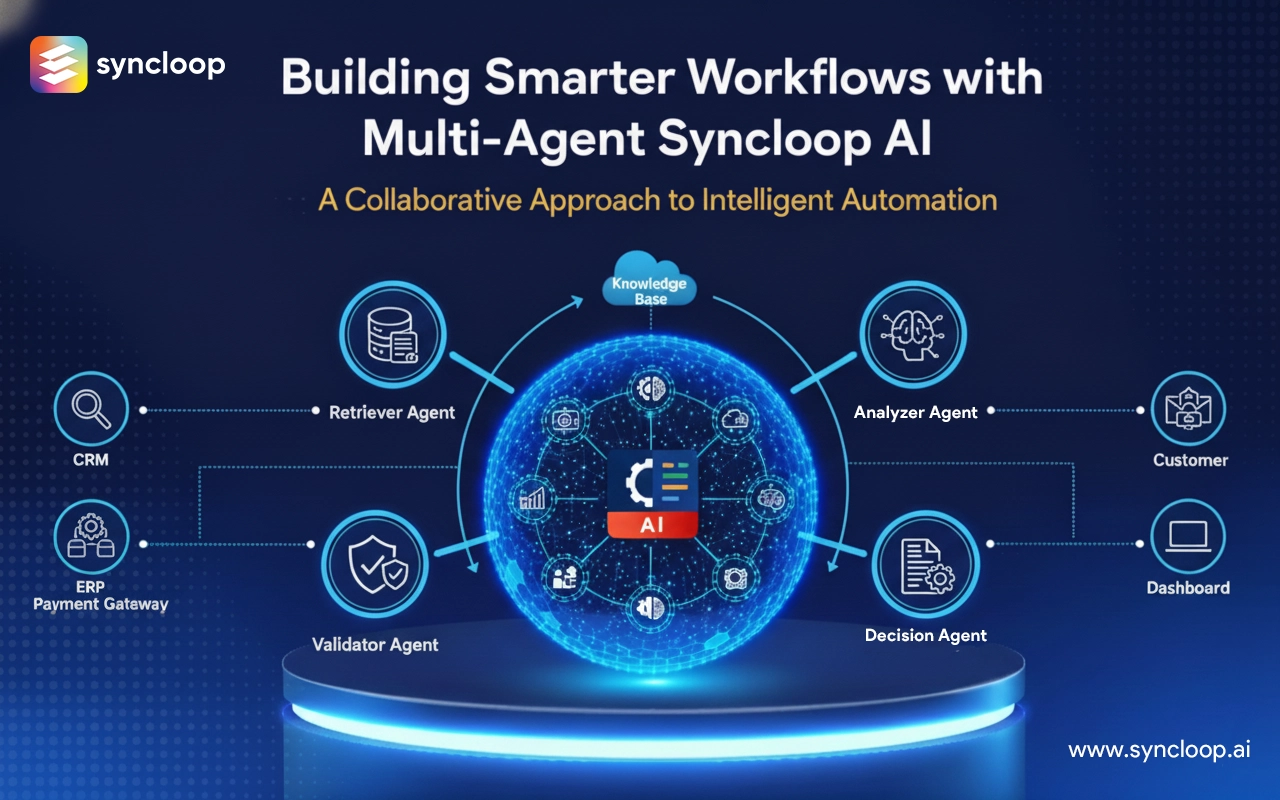
Use Case: Automating a Customer Refund Process
-
Agent 1: Ticket Intake & Classification
This agent scans incoming refund requests (emails, forms,
chat messages), understands the request using an LLM, and
classifies the issue.
-
Agent 2: Purchase Validation
Another agent pulls order history from your CRM or ERP,
checks eligibility rules, and verifies if the refund is
valid.
-
Agent 3: Refund Processing
This agent initiates the refund through the payment gateway
and updates the financial system.
-
Agent 4: Notification & Reporting
A fourth agent informs the customer, logs the event, and
sends a summary to the finance team dashboard.
Each agent works independently but in coordination, passing
information as needed, responding to outcomes, and ensuring
the process runs end-to-end without human delay.
That’s not just automation—that’s workflow intelligence.
The Syncloop Advantage: Built for Humans, Powered by AI
One of Syncloop’s greatest strengths is its human-centered
design. Unlike legacy platforms that require deep technical
expertise, Syncloop offers a visual, low-code interface that
allows business users to build and modify workflows
themselves.
Users can:
- Drag and drop components to create flows.
- Assign AI agents with specific roles and logic.
- Monitor workflows in real time.
- Use templates to accelerate setup.
At the same time, developers can go deeper, integrating APIs,
embedding scripts, or customizing logic as needed. It’s a
platform that works for both sides—business and technical.
This makes building smart workflows not only more accessible,
but also faster and more collaborative.
Smarter Workflows = Better Business Outcomes
So what’s the real impact of smarter, agent-powered workflows?
-
Faster Execution: Parallel processing by agents speeds up
workflows that used to be sequential.
-
Better Accuracy: AI agents reduce human error by following
logic consistently and validating inputs.
-
Improved Agility: Teams can modify workflows quickly without
needing to rebuild entire systems.
-
Deeper Insights: Real-time tracking and analytics help teams
see where delays occur and improve over time.
-
Enhanced Customer Experience: Faster, smarter processes lead
to quicker resolutions and more responsive service.
Whether you're in retail, finance, healthcare, logistics, or
SaaS—these benefits translate directly into operational
efficiency and competitive advantage.
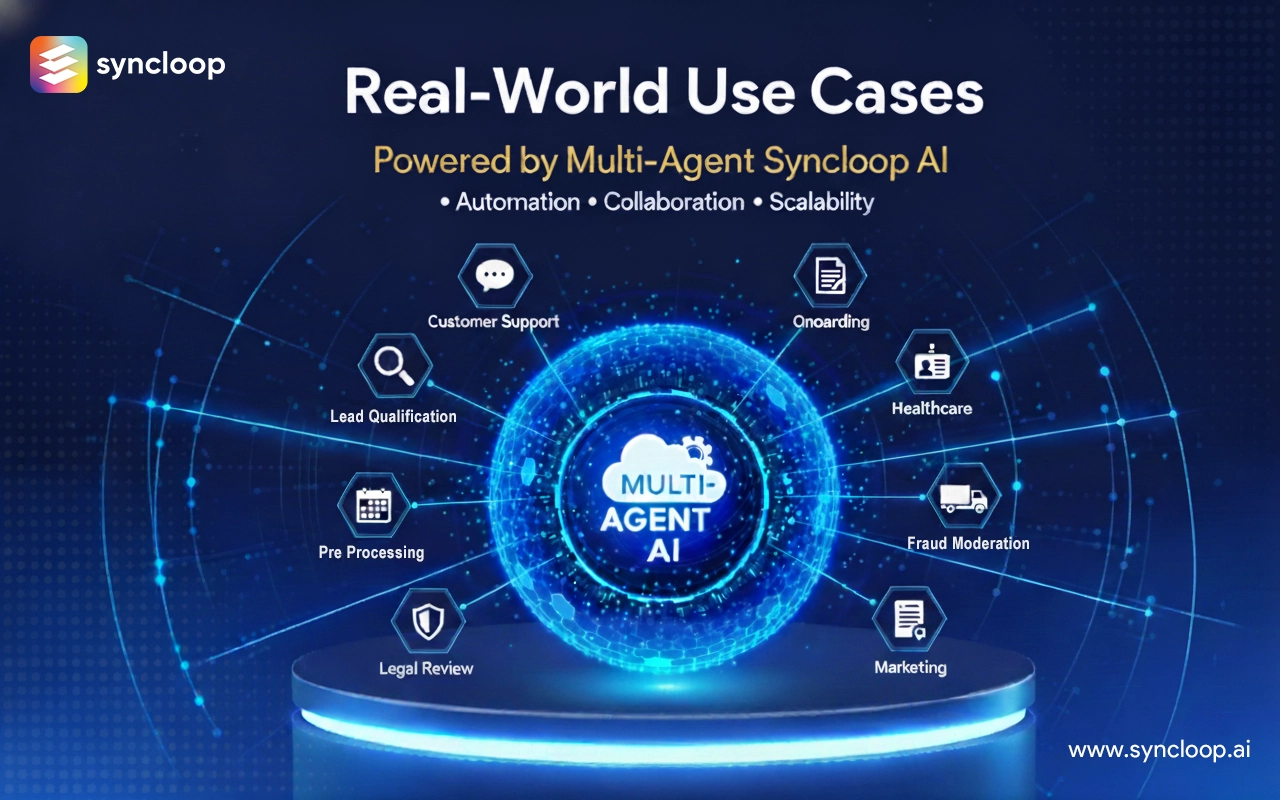
Real-World Use Cases of Smarter Workflows
Here’s how some companies are already using Syncloop AI to
build smarter workflows:
-
Retail: Automating multi-channel order fulfillment with
agents handling stock checks, shipping coordination, and
customer notifications.
-
Healthcare: Streamlining patient onboarding by integrating
forms, insurance verification, and appointment scheduling
through specialized agents.
-
Finance: Automating approval chains for reimbursements and
expenses with dynamic routing and validation based on
employee roles.
-
Support Teams: Classifying tickets, suggesting responses
using LLMs, and escalating complex cases—all managed by a
network of collaborative agents.
These aren’t future ideas—they’re real workflows running
better, faster, and smarter today.
The Future is Modular, Intelligent, and Collaborative
As digital ecosystems grow, businesses are looking for
platforms that are modular, intelligent, and able to evolve.
The days of one-size-fits-all automation are over.
With Syncloop AI’s multi-agent framework, you’re not just
building a process—you’re building a digital workforce that
can think, communicate, and scale with you.
You can start small—automate a simple workflow—and expand
gradually. Each agent you add becomes a reusable resource that
strengthens your operations.
This is how modern businesses will build the future: not with
static processes, but with smart systems that collaborate in
real time.
Conclusion
Building smarter workflows isn’t about chasing trends. It’s
about giving your team the freedom to focus on meaningful work
while letting intelligent systems handle the rest.
Multi-Agent Syncloop AI makes that possible.
It turns fragmented, manual tasks into coordinated,
intelligent flows. It empowers both technical and
non-technical users to participate in automation. And it
adapts to your business—today, tomorrow, and into the future.
If you're ready to move beyond traditional automation and into
a world of intelligent collaboration, Syncloop AI is the
platform that gets you there.
 Back to
Blogs
Back to
Blogs